


Welcome
Positive Induction Toolkit
Whether you're here to be better informed or to prepare for an upcoming induced birth, you will feel clarity, empowered and far less anxious after working through this Toolkit.
"I just wanted to say thank you so much for your help! Whatever the outcome tomorrow, I feel more prepared to go into the hospital and discuss my options and ask lots of questions before we make our decision.
The call and Toolkit have been so helpful to put me in a better frame of mind.
Thank you so much for your help and advice - I will keep you posted with what happens next!"
Nathalie, first time mum who used the Toolkit and booked a 121 Virtual Power Hour with me to help her decided whether to opt into induction and prepare for one if she did.
How to use the Toolkit
You have lifetime access so can digest the content at your own pace, perhaps together with your Birth Partner. All we ask is that you please don't share it with anyone else. Content is shared as a mix of written content, PDF Guide, Digital Modules and Audio Recordings.
If time allows, there are conversation prompts to have with your birth partner, questions to ask of your midwife or consultant to support you to make your decision whether to opt in. There is also a birth plan template to capture your preferences. Making time to complete all the activities will completely prepare you in mind and body.
If you have already consented to an induction and the procedure is imminent, then I would focus on the 'How to make Induced Birth Positive' Section and completing your birth plan.
There is also access to Hypnobirthing audios written specifically with induction in mind. Listening to these regularly will help release fear and anxiety.
There is a dedicate video module for Birth Partners to equip them to best support you.
Overall this is your Complete Guide to a Positive Induction!
If you would like more personalised support...
I do offer Virtual Power Hours for £60 which give you the chance to ask specific questions, gain my support and reassurance and potentially clarity. Where applicable, I will follow up via email sharing relevant resources or signposting to trusted sources of information.
Please get in touch if you would like to book a session.

Let's get started
What is induction and why might you be offered it?
In simple terms, an induced labour is one that's started artificially. And it's fairly common.
Labour can be induced if your baby is thought to be overdue or there's any sort of risk to you or your baby's health. This risk could be if you have a health condition such as high blood pressure, for example, or your baby isn't growing as expected. Other reasons might be that your waters have broken and after 24 hours labour hasn’t progressed so there’s a risk of infection. Gestational diabetes and a mum being over 40 are some other reasons why you may be offered an induction.
If it's a controlled medical procedure, why do we hear so many horror stories about it?
I believe this is down to two things: 1) the birthing woman being unprepared or poorly informed about the procedure and experience and 2) the very nature of a more medicalised process and environment isn't conducive to an efficient and comfortable birth so it is much hard for your body to respond positively to the procedure. If a birthing woman is feeling emotions like fear, panic and stress then her body will resist the process making it much more uncomfortable and increasing the likelihood of further intervention.
Statistically, there is an increased chance of further intervention if you consent to induction. For example, at my local hospital East Surrey, 38% of first time mums who consent to induction will actually end up birthing their baby via c-section. (source)
One of the reasons for this is often the contractions start suddenly and are stronger and more painful than contractions that start naturally. This may mean you need pain relief such as an epidural, which may not have been something you would have needed otherwise or originally wanted to have. Having an epidural then also increases the chance of further interventions.
Another big factor is that induced labour can take a long time to be effective. I always suggest my clients prepare to be in hospital for 3 days as they go through the various steps of the process. In my local hospital flyer they state the average stay on the ward is 72 hours. You will get little quality rest, privacy or food during the process and birthing women are often exhausted before they even reach active labour. Therefore, another factor contributing to the increased likelihood of needing pain relief.
How long does induction take?
This depends on the methods used and how your body responds to them. It can take hours or days depending on your situation. If this isn’t your first baby and you have gone into labour naturally before, your body will generally react faster than if this was your first baby. You’ll have to attend hospital or may even be admitted so you should prepare for this when starting the induction process.
How do I decide if it's right for me and my baby?
Inductions are usually planned in advance, so you will have the opportunity to discuss the pros and cons with your midwife or doctor. A good question to ask is what happens if you do nothing. If there’s no medical urgency you may choose to wait as most women go into labour naturally (spontaneously) by the time they're 42 weeks pregnant. But then some women are ready to get their babies out and are happy to get things started! If your pregnancy lasts longer than 42 weeks and you decide not to have your labour induced, you’ll likely be offered increased monitoring to check your baby's wellbeing. Ultimately, whether or not you have your labour induced or not is a decision to make with your midwife or doctor but here are some decision making tools to support you to work through it:
Tips for avoiding unnecessary medical intervention
Intervention can be life changing and amazing for mum and baby when one or both is at risk. So this is not against situations where there is a serious risk of harm to mum or baby. However, I know that you will likely be aiming to avoid unnecessary medical intervention during your labour.
This may be for a variety of reasons but I’ll also share that we know - and I often hear this when talking to mums postnatally - that opting into one form of intervention is more than likely going to lead to a domino effect. So whilst the intervention being offered to you may sound straight forward, know that it will have an impact on the journey your birth takes from then on. So here are some key questions I always recommend you ask to help you make decisions:
-
Is this recommendation based on Hospital Policy* or a Medical Recommendation?
-
Don't forget to ask how this may affect your birth choices and preferences.
-
Can you give me those statistics in numbers not percentages?
Analyse the language that is used. Often the way information is communicated or presented heavily influences our decision. But you don’t want to make decisions out of fear or just because the person speaking thinks you should.
For example listen to these statements: -
24 hours after your waters break the risk of infection to your baby doubles
-
24 hours after your waters break the risk of infection to your baby increases from 0.5% to 1%
-
24 hours after your waters break the risk of your baby not developing an infection changes from 99.5% to 99%
How do you feel after hearing these? You see the facts are the same but the way they are presented alters and this alters your decision. So I always suggest asking for risks or benefits in real numbers, not percentages or broad generalisations like ‘doubles’.
* Hospital Policy such as this is their default / routine recommendation for your situation. But that doesn't mean there is a medical risk that the intervention could reduce and therefore improve outcomes.
Making Informed Choices: A useful tool for working through these sorts of decisions is the BRAIN thought process:
B - what are the benefits? Ask what the benefits are of the action being offered and consider what the benefits would be to you personally.
R - what are the risks and repercussions? Are there any repercussions, side-effects or risks that come with this procedure? Ask for the facts and evidence on which they’re based.
A - what are the alternatives? Are there other options or courses of action that you could take? Also apply BRAIN to any of those. Ask for a second opinion.
I - what does your intuition tell you? Listen to your instincts and tune into your body and your baby. Trust that deep down you know the best course of action for you and your baby. Tell your midwife or doctor what you instinctively feel.
N - what happens if we do nothing? Ask what will happen if you just wait and see what happens. Or if you’re already in labour - ask even for a little time before giving your answer. You may appreciate the time just to reflect and breathe before taking action and it helps you feel more in control.
Only once you have the answers to your questions and information about why your care provider believes the intervention will lead to better outcomes can you decide if induction is right for you and your baby.
Trusted Sources of evidence-based information:
Dr Sara Wickham, a midwife and academic researcher, analyses research and shares findings in accessible blog posts. For example she analyses the evidence for induction in cases of gestational diabetes, for advanced maternal age, for post due dates. She also has a book dedicated to Induction of Labour. See her resources here.
The Process of Induction
The aim is to do as little as possible to trigger the body into labour and for your body to then take over. So whilst this is the typical sequence of induction, not every woman will need every stage.
1. Membrane sweep, also known as a "cervical sweep" or “stretch and sweep”.
-
Note to number of women having labour induced via a sweep is omitted from most hospital dashboards so the true number of women having inductions is far higher. This is because hospitals don't see sweeps as a form of induction but in reality it's sole purpose is to trigger your body into labour.
-
This is a manual procedure carried out by your midwife or doctor - they sweep their finger - wearing gloves - around your cervix during an internal exam.
-
They can be carried out during a normal antenatal appointment in your own home or at the clinic, so there’s no need to go to the hospital to have this done.
-
The sweep increases the chances of you going into labour within 48 hours, but it’s not a guarantee. If the sweep isn’t successful, you can have another one a few days later, if you want to and your midwife agrees.
2. Synthetic (artificial) prostaglandin hormones
-
Propess, pessary: Containing the hormone prostaglandin. This is released naturally by the body in labour, to soften or ‘ripen’ the cervix. A Synthetic Propess pessary will be inserted into the vagina and behind the cervix, and can remain for a maximum of 24 hours before removal. Sometimes you will be allowed home but you may need to persuade your care team that this would be beneficial.
-
Prostin, gel or tablet pessary: Containing the hormone prostaglandin. This is inserted into the vagina, behind the cervix and releases the hormone over a 6 hour period.
-
Prostin is the typical method of induction for those who have prolonged rupture of membranes (waters breaking more than 24 hours ago) where labour has not started spontaneously.
-
Prostin will also be used as second method if initial Propess has not opened the cervix enough to enable artificial rupture of membranes
- Can you still use the Birthing Centre? Following induction of labour using Propess (when not requiring continuous foetal monitoring) you may be deemed suitable to use the Birthing Centre. However, an initial CTG will be required to rule out foetal hypoxia (baby showing signs of distress/lack of oxygen).
- Possible side effects of synthetic prostaglandin hormones include: feeling sick (nausea), being sick (vomiting), diarrhoea (runny poo), hyperstimulation of the womb. Hyperstimulation of the womb means your womb is contracting too much. This could affect your baby’s heart rate. If this happens, your midwife or doctor will try to slow your contractions by stopping this medicine and, if possible, removing it. They may give you a different medicine to slow your contractions. It can also increase your discomfort and increases the likelihood of pain relief.
3. The next stage can vary by hospital: Osmotic dilator (cervical rods) or Balloon catheter.
-
Osmotic dilator (cervical rods), East Surrey use Dilapan-S: Dilapan are non-medicated soft rods (East Surrey describes them as similar to a cotton bud, if you want to see an image click here) made of hydrogel, which absorbs the fluid from the cervical tissue. Using a speculum, a midwife will insert 3-5 rods into the cervix, which can each expand to 15mm. These can remain for 12-24 hours and can dilate the cervix so your waters can be broken.
-
Dilapan is the recommended method of induction for VBAC (vaginal birth after caesarean section) women who will be offered Dilapan as the first line for induction of labour.
-
-
Balloon catheter (a Foley bulb or Foley balloon), at Epsom Hospital: is a catheter-like device that is inserted and gently inflated with saline solution to encourage the cervix to soften and open (click to see an image here). Sometimes it’s comfortable enough to move about and you may be permitted to go home.
4. Artificial rupture of membranes (ARM or “breaking or releasing your waters")
-
Once the water or membranes can be broken - your cervix needs to be slightly dilated first - the midwife or obstetrician will perform a vaginal exam and use a slim plastic hook to break the waters. If the liquid is clear and there is no sign of distress in your baby most women rest to see if labour will start naturally. You’ll have to remain in the hospital at this point.
5. Hormone drip
-
If after your waters have broken there is no sign of regular contractions, a cannula will be inserted to pass an infusion of synthetic oxytocin - the hormone that stimulates the uterus to contract. Baby is continuously monitored as there’s a risk of foetal distress. Mum’s mobility is also restricted a little due to the drip but some hospitals have mobile or even waterproof set-up’s so you could use a birth pool so it is always worth asking about these before they go ahead.
-
Once labour starts, it should proceed normally, but it can sometimes take 24 to 48 hours to get you into labour.
Birthing your placenta after induction
After your baby is born, you will need an additional dose of Synthetic Oxytocin in to help you birth the placenta , this is called ‘Active Management’ of the Third Stage of Labour. This has been shown to reduce the risk of losing too much blood after birth in induced labours. It should still be possible to request optimal cord clamping, where you wait for all of babies blood to transfer along their cord and the cord then appears white, "wait for white". A third of your babies blood will be in their placenta at any one time so making sure they have this blood can support their transition after birth.
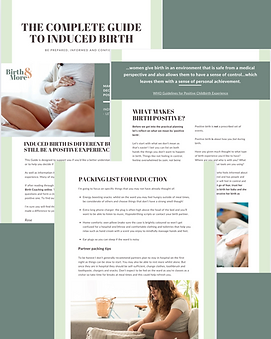
The Complete Guide to Induced Birth
Download a copy of my carefully curated 'Complete Guide to Induced Birth' and read through it with your Birth Partner. You'll find additional information on:
-
Pain Relief options for Induced Birth
-
Practical ways to support a more efficient and more comfortable induced birth
-
Packing list for induction
-
Induced Birth Plan Template to print and capture your preferences
-
List of Positive Birth Affirmations to support your preparation
Digital Modules
Short Digital Antenatal Course is a series of 21 short videos, lasting just a few minutes each. Allowing you the change to digest bite sized nuggets of education.
Includes demonstrations of 3 different breathing techniques for the 3 main stages of labour, explanation of Hypnobirthing and the Fear, Tension, Pain Cycle, a dedicated Birth Partner Module and Fourth Trimester Module.
Pregnancy Yoga Class a bonus module to familiarise you with positive birth movements and positions.
How to prepare for induction and make it a positive, empowering experience!
Firstly, much like preparing for spontaneous birth, it's important to try and buffer yourself from negative stories. This may mean a digital detox or limited social media time in the days leading up to your induction. I'd also recommend not telling too many people the date of your induction as you don't want to be updating everyone during the process! I'd also avoid using your phone during the procedure, rest when you can, watch TV that makes you happy, relax listening to feel good music or guided relaxations or read. Allow your mind and body to be all in and focused on supporting the medical process so that your body responds positively.

How can you help the induction process
As we’ve seen above, induction makes your experience much more medicalised and it would be easy to become passive in the process and lose your sense of control. However, there are lots of ways you can support the induction process and make the overall experience more positive and feel empowered throughout.
-
Being prepared for a lengthy process can help manage expectations and anxiety.
-
Rest before the procedure and avoid stress triggers so you begin the process in a good state of mind and health.
-
Know what hormones are needed for efficient and more comfortable birth and what they need to flow. Watch the Antenatal Videos.
-
Learn about the mind-body connection and how to induced a mindset conducive to a positive birth experience. Explained below.
-
Create a calm and comfortable birthing environment so you can relax even on a hospital ward.
-
Use breathing and relaxation techniques such as hypnobirthing tracks and visualisations to maintain a calm mind. Practice the Breathing techniques in the Antenatal Videos.
-
Talk to your birth partner about how you're feeling about the procedure and how you'd like them to support you.
-
Birth partners should inform themselves of the process and have what they need to be comfortable throughout and to focus on supporting you.
-
Identify any practical considerations that could distract you during the procedure and make arrangements. For example care of a pet whilst you're in hospital, childcare for older siblings and your birth partner to give notice to work.
The Power of Hypnobirthing for Induction
Just because induced labour is very medicalised does not mean there’s no place for Hypnobirthing. In fact I’d argue it’s ever more important and I’ve had several clients find it extremely beneficial. Hypnobirthing techniques support you to let go of fear around birth and promote feelings of calm and confidence - still relevant in induced birth. These feelings provide the right environment for birth hormones to surge and prevent stress hormones from dominating and ultimately derailing your birth.
The Mind-Body Connection
Simply put, how you feel alters the chemical balance (hormones) and triggers a physical response. If you feel scared, anxious, stressed, then stress hormones (Adrenaline and Cortisol) will surge and inhibit birth hormones (Oxytocin and Endorphins) slowing or even stopping your labour from progressing.
Ideally you want to be present in your Parasympathetic Nervous System, your calm state of mind, during labour. This allows you to turn inward and let your body lead. If you labour in your Sympathetic Nervous System instead your Fight, Flight or Freeze mode will be activated and your body will think it’s not safe to give birth and slow or stop labour. It’s still possible that your Fight, Flight or Freeze mode may be activated when using Hypnobirthing, but you’ll be equipped to take back control and not let it dominate.
Hypnobirthing doesn’t take away the sensation of your contractions but it prevents you from feeling overwhelmed by them. This could really make a difference when induced birth often causes more intense contractions.
Hypnobirthing works using Guided Relaxation Scripts, Anchors and Techniques such as Touch or Breathing Techniques, to move you from fearing birth towards calm, confidence and learning to trust your body. Practicing these techniques frequently in pregnancy means they’ll be very powerful during labour. I also have a set of recorded scripts dedicated to supporting women preparing for induced birth.
How does Hypnobirthing work?
In simple terms hypnosis is an 'alternated state of consciousness’.
It might surprise you to know that we all enter into hypnosis at least twice a day when we are falling asleep at night and again when we wake in the morning.
This simply means that when we are very relaxed, the conscious part of our minds will move to one side, allowing the unconscious part of our minds to be open to receiving suggestions. The unconscious mind is where imagination, long-term memory and behavioural response patterns are stored. Remember what we just discussed about the mind-body connection.
Hypnobirthing is a form of self-guided controlled hypnosis.
I won’t be there to induce the state of hypnosis - you will learn how to do it yourself.
It’s called ‘controlled hypnosis’ because you are still awake.
Just as in hypnosis, the core hypnobirthing technique is guided relaxation scripts and recordings. These also use visualisations and repeated affirmations.
So you will learn how to switch off your logical, thinking, conscious mind and tune into your unconscious mind, and flood it with positive words, sensations and visualisations about birth to reinforce to you and your body that you can and will have a positive birth experience. Remember that point about the unconscious mind being where behavioural response patterns are stored - we want to link a calm, positive response to the idea of birth so that when it does happen your body doesn’t perceive it as a threat and trigger the fight, flight or freeze mode. It’s not a medical crisis, we don’t need to panic.
And there are studies out there where half the group did an exercise and the other only imagined it. The group who imagined it still saw an increase in strength in the muscles activated. So your imagination does have the power to impact you physically. That's what we want to tap into during your labour so that your body responds in the ideal way.
Anchoring is another technique used in Hypnobirthing. It simply means that, in hypnosis, you use a trigger that can be used quickly and easily to achieve the desired effect at any time. Examples of anchors: breathing techniques, scent, same music and I use the same backing track for all my mp3s for that reason, visualisations, words and positive affirmations. You can choose your own anchors and by using them frequently, perhaps when you listen to your scripts, they can have a powerful effect in labour. You must be familiar with them and have a positive association.
Your Hypnobirthing Scripts
The key to successful hypnobirthing is repetition and practice. There’s an interesting rule of thumb that says it takes 3 iterations to install a new belief and you need 7 iterations to overlay, remove and replace a negative belief with a positive one. So practicing each script 3-7 times a week will be plenty of opportunity to build confidence and even excitement about your birth. You can listen to scripts before bed or when you have time to relax.
Birth partners can support you by helping you to make time for practice and creating a lovely environment in which to listen to your scripts. I’d encourage you to talk through what anchors you might use and what environment would help you relax. You can replicate this in labour.
Your Playlist: I suggest listening to them in order first, all under 10 minutes each, then revisit any you need at the time.
Script 1: Finding Acceptance That Induced Birth Is the Best Way for My Baby to Be Born
Script 2: Letting Go of Fear Around Induced Birth
Script 3: General Relaxation on the Hospital Ward
Script 4: Forming Calm Confidence Around Induced Birth

Wishing you a positive birth experience!
I hope you have found the content shared here valuable and enlightening. You should be feeling much better informed and prepared which in turn will help ease anxiety ad uncertainty. Be sure to be an active participant in your antenatal appointments and discussions around induction with your care providers.
If you'd like my further support please get in touch for a 121 Virtual Session.
Otherwise I'd love to hear how this course has helped you prepare for birth and ultimately if you found it made a difference after you give birth please let me know! rose@birthandmore.co.uk
And if you live locally to Dorking, Surrey, I hope to see you and your little one in Baby Classes one day.
Sending positive birth vibes!
Rose
_websize.jpg)


Mum & Baby Support & Classes in Dorking, Surrey
.png)
.png)

.png)